12 Ways to Spot Fake WhatsApp Forwards in India (2026)
Every Indian WhatsApp group has a few people who forward everything. Your uncle who sends three "URGENT" health warnings before 8 AM. Your mother's kitty party group where miracle cures for diabetes circulate alongside festival wishes. Your father's housing society group where a "government scheme" promising free gas cylinders gets forwarded 47 times in one day.
Most of these forwards are harmless at best. But a meaningful number cause real harm: people change medications based on fake health advice, send money to fake government schemes, or live in fear of diseases or threats that don't exist.
Here are 12 reliable signals that a WhatsApp forward is fake, manipulated, or misleading. Share this with your parents. Or better, go through it with them once — it's more likely to stick.
The 12 red flags at a glance — full explanation of each below.
| Red flag | What it means |
|---|---|
| 1. "Forwarded many times" | Spread through long chains — viral, not verified. |
| 2. "Share in the next 10 minutes…" | Manufactured urgency to stop you verifying. |
| 3. Instant intense fear or anger | The emotion was engineered to bypass your reasoning. |
| 4. No source, author or date | Vague "doctors say" / "govt announced" with no specifics. |
| 5. Image doesn't match the story | Old or unrelated photo reused — reverse-search it. |
| 6. Suspicious links and URLs | Lookalike domains (sbi-kyc-update.com) and shorteners. |
| 7. "Official" docs that look slightly off | Wrong logos, typos, Gmail instead of .gov.in. |
| 8. Medical claims with no doctor name | No named study, journal or institution. |
| 9. Too-good "government" schemes | Free money via a WhatsApp link — never real. |
| 10. "Leaked" videos of public figures | Possible deepfake — check blinking, lip-sync, edges. |
| 11. No verifiable location | Vague crime/disaster with no place, time or FIR. |
| 12. Already debunked by fact-checkers | Search AltNews / Boom before forwarding. |
| Not sure? Shortcut | Forward it to FamAI — instant plain-language verdict in Hindi. |
Set up FamAI for your parents →
Red Flag #1: "Forwarded Many Times"
WhatsApp labels messages that have been forwarded more than five times with a double-arrow icon and the text "Forwarded many times." This is not a badge of credibility. It means the message has spread through long chains of contacts — which is exactly how misinformation spreads.
Real news from reliable sources doesn't need to travel through 47 contacts. It goes directly to you from a news outlet, official account, or journalist. If it's "forwarded many times," treat it with extra suspicion, not less.
Red Flag #2: "Share in the Next 10 Minutes or…"
Any message that creates urgency around sharing — "forward this to 10 contacts or something bad will happen," "valid only for 2 hours," "share before WhatsApp deletes this" — is manipulating you emotionally. Real information doesn't expire if you don't forward it.
This pattern is used for two purposes: to prevent you from taking time to verify, and to make you complicit in spreading it. Pause whenever you feel pressured to act immediately.
Red Flag #3: It Makes You Feel Intensely Scared or Angry — Instantly
This is the most important one. If your gut reaction to a message is immediate, intense fear, outrage, or disgust — that reaction was probably engineered. Fake content is designed to hijack your emotions before your reasoning can catch up.
"Hindu temples being demolished across UP" (with an image from a different country, 10 years ago). "Onion price will be ₹500/kg next week" (no source). "New cancer-causing ingredient found in [popular brand]" (unnamed "study," unnamed "scientists"). Each of these is calibrated to trigger a specific strong emotion.
The rule: if you feel an intense reaction, that's the moment to slow down and verify — not to forward.
Red Flag #4: No Source, No Author, No Date
Real reporting has a byline, an outlet, and a date. Real government notices have official letterheads, seal, and contact details. Real medical advice cites journals, institutions, and doctor names.
Fake forwards are typically unsigned, undated, and un-sourced. They say things like "Doctors are warning that…" or "Government has announced…" without specifying which doctors, which government body, where to verify. The vagueness is intentional — it makes the claim impossible to disprove.
Red Flag #5: The Image Doesn't Match the Story
A photo of flooded streets from a 2012 disaster reused to claim a flood happened yesterday. A hospital image from Bangladesh used to claim medical negligence in Delhi. A fire in an old building used as "proof" of communal violence.
How to check: On Android, open Google Lens and photograph the image. On iPhone, long-press a Safari image and choose "Search Image." Or save the image and upload to images.google.com. Google will show you where else the image appears online — often revealing it's years old or from a completely different context.
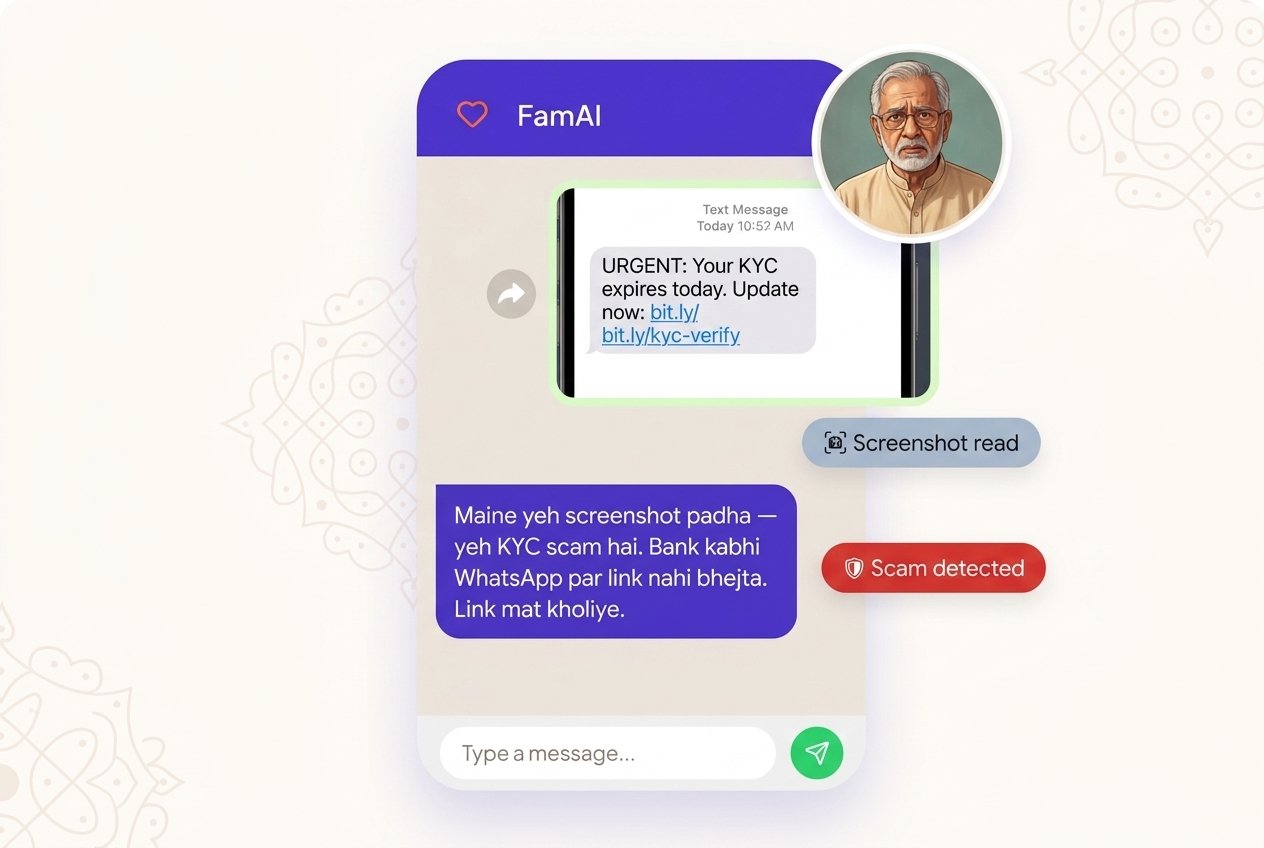
Red Flag #6: Suspicious Links and URLs
Fake forwards often contain links. Look carefully at the URL before tapping. Common tricks:
- sbi-kyc-update.com (SBI's real site is sbi.co.in)
- gov-india-scheme-2026.net (government sites end in .gov.in)
- bit.ly/win-prize-now (URL shorteners hide the real destination)
- aadhaar-verify.online (UIDAI's real site is uidai.gov.in)
Rule: if you're unsure about a link, don't tap it. Go directly to the official site by typing the address yourself.
Red Flag #7: "Official" Documents That Look Slightly Off
Scammers create PDFs and images that look like government circulars, Supreme Court orders, or RBI notices. They're close enough to look real at a glance but have tells: incorrect logos, spelling errors, unusual fonts, or a Gmail address where there should be a .gov.in email.
Real government orders can be verified at their official websites. RBI circulars are at rbi.org.in. Supreme Court orders are at sci.gov.in. If someone shares a "government order" on WhatsApp that isn't on the official site, it's not real.
Red Flag #8: Medical Claims with No Doctor Name
"Scientists have discovered that drinking hot water with lemon every morning cures diabetes." "New research shows that [common medicine] causes cancer." "Doctors in AIIMS have found that [home remedy] is better than chemotherapy."
Real medical research is published in journals (PubMed, Lancet, NEJM), attributes to named researchers and institutions, and goes through peer review. It doesn't arrive via WhatsApp. If a health claim doesn't cite a named study, a journal, and an institution — it should be ignored, not forwarded.
Medical misinformation has real consequences: people have stopped legitimate medications, avoided necessary treatments, and taken harmful "remedies" based on WhatsApp health advice.
Red Flag #9: Too-Good Schemes from "Government"
"Modi government giving free solar panels to all households — apply now." "Government scheme: all women above 60 to get ₹3,000 per month — click link to register." These circulate constantly.
Real government schemes are announced in Parliament, covered by mainstream media, and listed at official portals like india.gov.in or the relevant ministry's .gov.in website. They are never registered through a random WhatsApp link. Ever.
Red Flag #10: "Leaked" Videos of Public Figures
Deepfake technology has made it possible to put anyone's face on anyone's body saying anything. In 2025–2026, deepfakes of politicians, actors, and news anchors have spread extensively on Indian WhatsApp groups — mostly to spread political narratives or investment scams.
Signs of a deepfake video: slightly unnatural blinking, face edges that blur or shift when the head turns, audio that doesn't quite sync with lip movement, and lighting that doesn't match the background. Slow it down to 0.5x and look at the face carefully.
When in doubt, check if a major news outlet (NDTV, The Hindu, Indian Express) has reported on the video. Genuinely newsworthy politician statements get covered. If it's only on WhatsApp, be very sceptical.
Red Flag #11: The Story Has No Verifiable Location
"A child was kidnapped from a park" — which park? Which city? When? Fake crime reports are often deliberately vague to make them hard to disprove and easy to believe. Real news reports have specific locations, police station names, FIR numbers, and named sources.
Vague crime or disaster reports spread panic without providing any information that could actually help. Before forwarding, ask: would this information help someone take action? If you can't answer that, don't forward it.
Red Flag #12: It's Already Been Checked by a Fact-Checking Site
India has several good fact-checking organizations. Before forwarding anything that seems significant, search for the claim on:
- AltNews — India's most thorough fact-checking outlet
- AFP Fact Check — strong on viral images
- Boom Live — focuses on viral misinformation in India
If a claim is widely circulating, it has likely been checked. Search "AltNews + [claim]" to find it quickly.
What to Do When Your Parent Shares a Fake Forward
This requires some care. Mocking or scolding them ("Arre Papa, yeh toh bilkul fake hai!") shuts the conversation down and makes them less likely to check with you next time. It also creates embarrassment that they'll want to avoid — which means they'll stop telling you what they receive.
Instead: "Dikh raha hai interesting — let me quickly check this." Then check it together. Make verification feel collaborative, not correctional. This gradually builds the habit in them too.
Tools That Help
The ideal situation is that your parent has a quick, easy way to check a suspicious forward before acting on it — without having to call you under pressure. Building a "forward to FamAI before you forward to the group" habit reduces how much misinformation your parents spread, and the risk that they act on a fake health or financial message.
Frequently Asked Questions
What does "Forwarded many times" mean on WhatsApp?
WhatsApp labels messages forwarded more than five times with a double-arrow icon. This indicates the message has spread through long chains of contacts — a strong signal to verify before trusting it. Viral spread is how misinformation travels, not how reliable news travels.
How do I do a reverse image search on my phone?
On Android, open Google Lens and photograph the image. On iPhone, long-press an image in Safari and select "Search Image". Alternatively, go to images.google.com and upload the saved image. This reveals whether the image is old or used in a different context.
What are the most common types of fake forwards in Indian WhatsApp groups?
Medical misinformation (false cures, fake health warnings), government scheme fakes (free schemes, prize claims), political deepfakes, religious fear messaging, and financial scams (investment returns, lottery wins).
How should I respond when my parent shares a fake forward?
Don't mock or scold — it shuts down the conversation. Say "let me check this quickly" and verify together. Make it collaborative, not correctional. This builds the verification habit in them over time.